
← TOOLSTOOLS — BOMBISTA

BOMBISTA

the one who sets the pace

Alleen in het Engels

Bombista makes the song file that everything else reads: what the song is, and when each of its lines is sung. It works the timings out from a recording, and then tells you which of them it doubts.

AT THE DESKPythonMIT

YOUR LYRICS TIMED IN THREE CHECKS, NOT FORTY

A song has forty lines. A tool that hands you forty timings and no opinion about any of them has given you a choice between trusting all forty and checking all forty, and the night before a gig you check all forty.

Bombista checks them for you. Every line comes back in one of three bands, with the reason attached: the ones it is confident about, the ones it wants a human to look at, and the ones it could not place at all. On a typical song that turns forty checks into three. Fixing one is a number typed into a box and takes a fraction of a second.
WHAT COMES BACK

One file, and it is the song. What it is: the words, the title and its translations, who wrote it, the tempo. And when each line arrives. Plain readable text you can open and check yourself.

This is where a song starts, because a lyrics file carries none of that. It is also the file Pregonero performs from.

ONE SITTING PER SONG

Your lyrics and a take, a tapped tempo, a minute while it works out where each line falls, and one listen through to fix the ones that landed wrong.

That is the whole cost, once per song, and it is spent at a desk days before anyone is in the room.

WHAT IT LEAVES ALONE

Your recordings and your lyrics files are never changed. It works from them and hands you something new.

It runs entirely on your own machine. The speech model downloads once, and after that nothing leaves the room: no account, no upload, no service in the middle.

And it does not translate for you. The song has a place for the room's language and Bombista leaves it empty, because how your words land in another language is a decision about the song and not a conversion. You fill it in yourself, with whatever help you choose. The format page says where those lines live in the file.

THREE STEPS

The way in is a local page in your browser. It opens on your own machine and nothing is served to anyone else.

bombista serve
1

INPUT

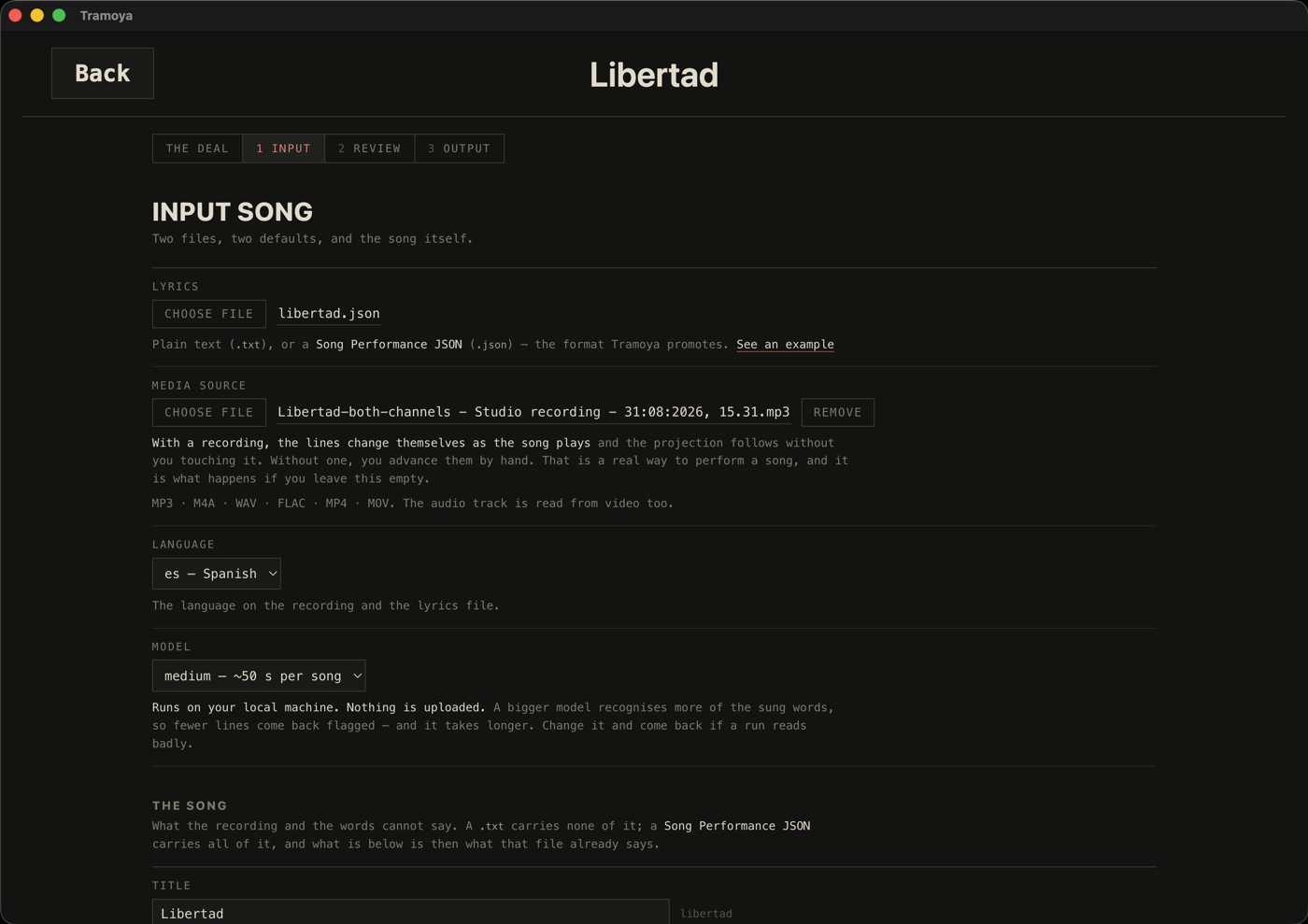
Point it at a media source, the recording, audio or video, and at the words: a song file, or a plain text file with one line per line. If the words arrive as plain text, this is also where the song gets its title, its artist, its tempo and its translated titles. Press Process song. It takes the better part of a minute.

Bombista's input step: a lyrics file and a studio recording both chosen, the sung language and the speech model set beneath them, and the song's own title and tempo fields below those.
2

REVIEW

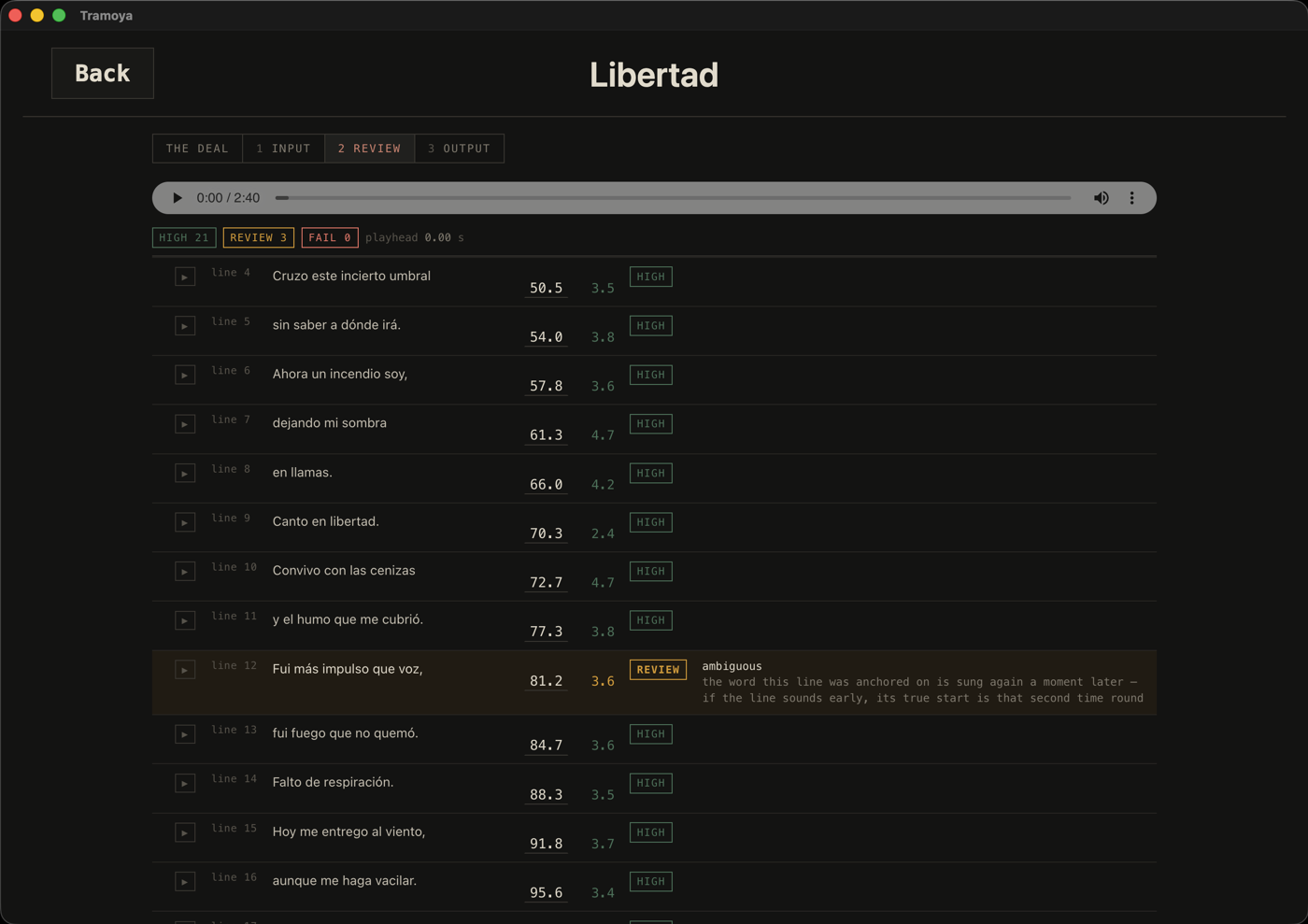
Every line, with its band and the reason for it. The confident ones need nothing. The ones it flags carry the signal that made it hesitate, and you can play any line to judge it by ear rather than scrubbing the recording in another app. Correct one and the timings re-settle around it.

Bombista's review step: a count of lines by band above a list of every sung line with its start time and its band, and on the one line it flagged, the reason it hesitated spelled out beside it.
3

OUTPUT

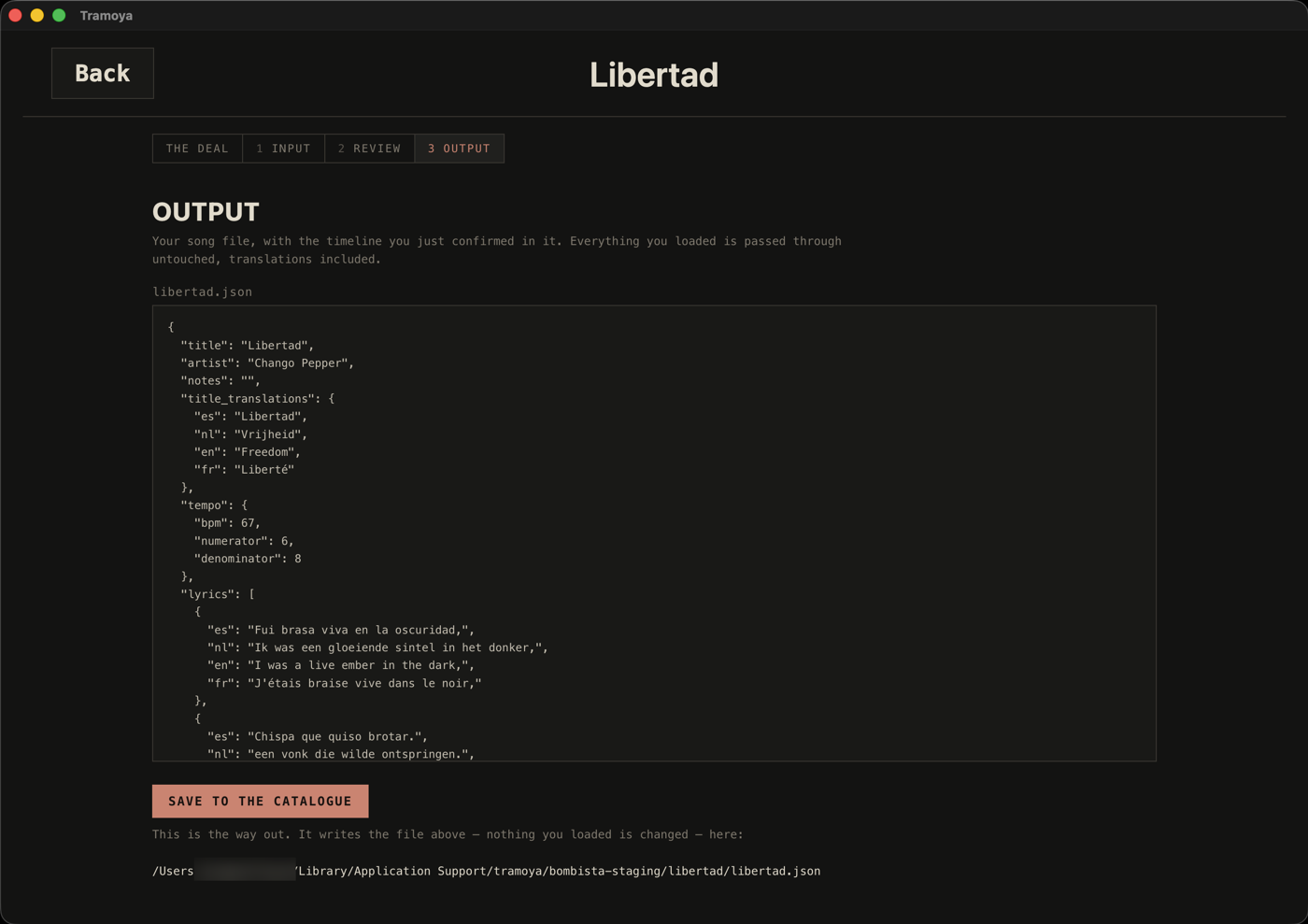
Three things to take away: the song, the timeline on its own, and a report on how the work went. The one that matters is the song.

Bombista's output step: the finished song file listed in full with its tempo and its four title translations intact, a button to save it to the catalogue, and the path it writes to underneath.

OR FROM THE COMMAND LINE

The same work, without the browser. Everything the page does is available as a command, and a few things it does not: subtitles written against the recording, an LRC, and an offline review page.

bombista align <recording> <song.json> -o <folder>